The New York Times has reported that Fisk University has revised the terms of the agreement with the Crystal Bridges Museum in relation to the Stieglitz Collection to address some of the concerns voiced by the Chancery Court in Nashville, Tennessee. Notably, "Fisk and Crystal Bridges have agreed that the art will remain at Fisk, in Nashville, until 2013, then be exhibited at Crystal Bridges for two years and returned to Fisk between 2015 and 2017. After that, the art will be on a two-year rotation unless the committee established to oversee the art “has a good reason to make a change,” the university said." A case example of how "the future will be shared," as the opinion section of The Art Newspaper so eloquently put it recently.
For background on the ongoing Fisk litigation see here, here and here. For a good analysis of the latest Fisk news see Donn Zaretsky's commentary on The Art Law Blog, which also includes a link to Fisk's court filing.
Thursday, October 14, 2010

ART PICK OF THE MONTH (Oct. '10)
"Lee Friedlander: America by Car"
Whitney Museum of American Art, New York 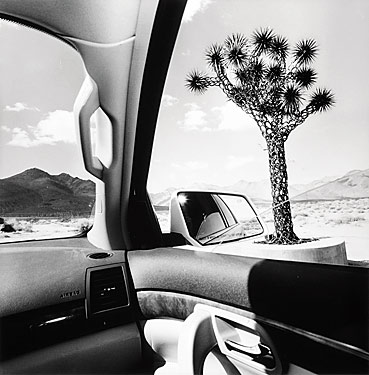 |
California, 2008, by Lee Friedlander |
Through November 28, 2010
The 192 photographs on display at the Whitney represent a visual narration of Lee Friedlander's travels across America over the last 15 years. At first, the images captured from the artist's rented car are so familiar to the viewer that he/she can't help but wonder whether they are worthy of any artistic value being attributed to them. I suspect the sentiment is underscored by many a viewer's cynical take on what gets passed off as "art" today and a somewhat enduring, albeit old-fashioned, belief that the medium of photography is inferior to painting or sculpture due to its accessibility to the non-artist layman.
While the content matter is, in my opinion, hardly new or exceptional (Americana all over again- Coca Cola signs, Joshua trees, billboards, the car itself...), the composition and lighting of the photos in no way resemble the arbitrariness of casual snapshots. Upon closer inspection, it's clear that a lot of thought went into the way in which the structures of the car (both inside and out) frame the landscape and its constituent objects, at times not merely capturing it but actually redefining it. The elements of the car become architectural structures within certain photographs- solid and stoical, embodying linear or curvilinear lines of some definite and purposeful design, magistral.... Likewise, the juxtaposition of different textures and intensities of light is thoughtful, subtle and highly effective in creating two clearly distinct worlds: the inside of the car and the world outside it.
Meanwhile, the curating of the exhibition, which was done in accordance with the artist's specific instructions, is spot on. The photographs are densely hung across the six walls of two small adjacent rooms in order to re-create the sensory overload associated with traveling in a car in America. And it works- the viewer feels overwhelmed by the vast number of images surrounding him in the tight, cramped space and, just like a car passenger, tries to take it all in as best he/she can. This way of displaying photographs reminded me of Julian Schnabel's curating of Dennis Hopper's retrospective at MOCA in Los Angeles last month except because the space was far smaller at the Whitney, the effect was quite different (as was the view of the photos- much better- given the size of the walls).
Definitely a worthwile trip to the Whitney though probably best combined with another exibit/ purpose for the visit as it doesn't take long to view the two rooms.
Sunday, October 10, 2010
Who says lawyers are always the bad guys?!
Finally- a story that may actually give lawyers a good name! Randol Schoenberg, President of the Los Angeles Museum of the Holocaust ("the oldest Holocaust museum in the US") and the lawyer who represented Maria Altmann in the much-publicized arbitration to recover her family's Nazi-looted Klimt paintings, has donated part of the fees he earned in the Altmann case to fund about a third of the museum's $18 million relocation and expansion costs. Read all about it here.
Bacon cricketer painting to go on sale Nov. 9 in New York
The 1985 painting "Figure in Movement" gifted by Bacon to his friend and doctor, Dr. Paul Brass, goes on sale November 9 at Sotheby's in New York. This is the first time the painting enters the market and it's estimated to sell for $7 to $10 million. The painting is quite special in a number of ways: it depicts a subject matter, cricket, which "fascinated" Bacon and the body and face of the cricketer are inspired by two of the painter's closest companions, also patients of Dr. Brass. The market always likes a good story so I wouldn't be surprised if the painting reaches or even surpasses the high estimate. Read all about the painting's unique story here.
Friday, October 08, 2010
Love a painting but strapped for cash? Try the photo-approach to obtaining art on the cheap (caveat: in most cases, it's ILLEGAL)
I am simultaneously annoyed and bemused when I see people taking photos of art displayed in a museum, artwork after artwork after artwork. I get annoyed because their main concern is digitally recording the fact that they were in the physical presence of the art rather than actually observing, absorbing and hopefully engaging with the art and because it ruins the experience for the rest of us. (At that moment, I'm often reminded of those travelers feverently focused on getting that Great Wall of China or Sydney Opera House snapshot just to mentally tick-off "China" and "Australia" from their cultural to-do lists). Then I wonder, somewhat confused, what it is these frenzied art paparazzi do with the photos afterwards. I picture them showing their encyclopedic catalogue of photos to friends and family shortly before stashing the camera and/or photo album away in the bottom of a drawer and long-forgetting about the art they went to see but never really saw. It had never occurred to me, however, that someone would think about blowing-up one of said photos and hanging it up on their wall though that is precisely what a freelance journalist envisioned (she never went through with it) as she revealed in a recent article in The New York Times.
Her main concern regarding the photo-approach to obtaining "art" for interior design purposes was ethical; what prompted her to write the article was whether it was in fact legal. After consulting various lawyers and law professors, it transpired that in most cases, it's illegal to photograph works of art, even if the reproduction is for your own private use only or the photo is a reproduction of a reproduction. In the US, if a work of art was created before 1923, it's considered to be in the public domain which means you can photograph it without violating any copyright laws. "But if the work of art is more recent, the artist generally has the exclusive right to any reproduction, and the piece is generally covered by copyright law," (my emphasis added). The statement that artworks created after 1923 are generally protected by copyright is a gross generalization and the key date is not one -1923- but several: 1978, 1989, 2002 and above all, the 70th anniversary of the artist's death. From 1923 to 1977, published works were only protected if the artist first "published" the artwork in the US (i.e. reproduced or publicly displayed it though determining the outer boundaries of the term is a challenge) with a copyright notice and renewed the notice during the year of the 28th anniversary of the first publication. If protected, the copyright term was 95 years from the publication date but as of 1978, protected works created after 1977 are protected for the life of the artist plus 70 years from the date of death (with some exceptions).
The formality of having to renew the copyright notice was abolished in 1992 but that didn't save the works published between 1923 and 1963 whose copyright notice was never renewed. According to a post on The Art Institute of Chicago's blog, "few artists remembered these deadlines and renewed their copyrights." What with the works that were published without notice and those that were but whose notice was never renewed, there must be a substantial number of relatively recent works that do not have copyright protection. It's not possible to summarise the intricacies of US copyright laws here nor am I in a position to do so (I'm not an IP lawyer!) other than to say that 1989 and 2002 also saw fundamental changes being introduced in the area of copyright law and, as before, protection turned on when and where a work was created and published and whether any applicable formalities were satisfied. It goes without saying that none of the above is intended to encourge the art paparrazzi to photograph art nor, I presume, is The New York Times' crucial distinction between violations and enforcement of copyright laws. The point I want to make is that copyright laws in the US are incredibly complicated and as a result, a significant portion of twentieth century art in this country has not been afforded the protection of the law. At least works published after 2002 automatically have copyright protection for the life of the artist plus 70 years from death (the shorter of 95 years from publication or 120 years from creation for works of corporate authorship).
Malborough Gallery sued over allegations that French dealer is selling fake Chinese ceramics
NEW YORK. French art dealer Enrico Navarra is suing Malborough Gallery in federal court for allegedly embarking on a ""systematic campaign" to deny the authenticity of more than 1,200 ceramic plates by famed Chinese artist Chu Teh-Chun and financed by Navarra and his Parisian business." Malborough is purported to have had the artist (aged 90 and currently ailing...) publicly denounce Navarra's plates as fakes. The motive? Money. Malborough had planned to sell a series of 57 vases by Chu for roughly $200,000 each but Navarra's own plans to sell a vast amount of the artist's ceramic plates threatened the gallery's commercial ambitions because it was anticipated that the market would be unable to absorb the increase in supply for these artworks and thus cause the market price to drop. "Meanwhile, Malborough - which has sold about half of its vases - has raised its price for the remainders to $280,000 each." Malborough did not return the New York Post's call for comments.
Subscribe to:
Posts (Atom)