Monday, March 28, 2011

UK to incentivise charitable donations the American way

LONDON. When UK public funding for the arts was cut by 30% last October, the question on everyone's mind was whether collectors would be able to make up the shortfall by increasing private donations such that the funding of cultural institutions would increasingly resemble that in the US. However, as this blog and many commentators pointed out, for this change in the funding structure to happen, the cut in public funding would have to be accompanied by the necessary tax incentives to induce charitable giving. The budget announced this week "unveiled several measures aimed at creating an incentive for would-be philanthropists to give more to culture" (more on the much-welcomed tax breaks from the FT.com).

As well as cutting inheritance tax by 10% for those who leave 10% of their estate to charity, the statement also "contained a long-called-for reform of Gift Aid." Gift Aid can now be claimed on small donations up to a total of £5,000 a year, per charity and much of the red tape surrounding Gift Aid has now disappeared (the government has created an online system as an alternative to filling out forms), cutting overhead costs for small organisations significantly.

Tuesday, March 22, 2011

"Deliver up for impounding, destruction, or other disposition, as Plaintiff determines, all infringing copies of the photographs"

 Left, a photo of a Rastafarian from Patrick Cariou's "Yes, Rasta"
and, right, a painting from Richard Prince's Canal Zone series
A US District judge has granted photographer Patrick Cariou's motion for summary judgment on the issue of copyright infringement by defendants Richard Prince, Larry Gagosian, Gagosian Gallery and Rizzoli books. Prince had admitted "to using at least 41 photographs from Yes, Rasta" but pleaded, unsuccessfully, "fair use." The doctrine of "fair use" is one of the more important limitations on copyright(developed through case law over the years and codified in § 107 of Title 17, U.S. Code). The section lists the various purposes for which a protected work may be reproduced without infringing the owner's copyright in such work. Uses considered "fair" include (the list is non-exhaustive) "criticism, comment, news reporting, teaching (including multiple copies for classroom use), scholarship, or research." Section 107 also sets out four factors to be considered in determining whether or not a particular use is fair: (i) the purpose and character of the use (including whether such use is commercial in nature or non-profit), (ii) the nature of the copyrighted work, (iii) the amount and substantiality of the portion used in relation to the copyrighted work as a whole and (iv) the effect of the use upon the potential market for, or value of, the copyrighted work.

There is no clear distinction between a use that is fair and one that constitutes copyright infringement but in this case, it's not hard to see why the defense didn't excuse Prince's use of Cariou's photographs. The use did not fall within any one of the purposes in § 107, the reproduction was hardly transformative (Cariou's photographs are easily recognizable in the Canal Zone Series photographs), it was purely commercial ("the less transformative a work, the more important its commerciality becomes") and the Canal Zone series was likely to have a direct impact on the market for the photographs comprising Yes, Rasta.  

Perhaps more interesting is the claim asserted against Larry Gagosian and his eponymous gallery. Intermediaries, though not using the copyrighted work directly, can nevertheless be found liable by distributing images that infringe copyright. All Gagosian defendants were held to be "vicarious and contributory infringers" after the judge ruled the they had "at the very least the right and ability (and perhaps even responsibility) to ensure Prince obtained licenses." The judge added: "the financial benefit of the infringing use to the Gagosian defendants is self-evident." A tough couple of weeks for Gagosian who just got sued by Robert Wylde for selling him a painting to which the seller did not have clear and unencumbered title (see here). Evidence is quickly mounting that Gagosian should adopt higher standards in the conduct of his gallery business (which we will undoubtedly learn more about in due course as the Wylde litigation proceeds).

Monday, March 21, 2011

UPDATE: Robert Wylde v. Gagosian Gallery, Inc.

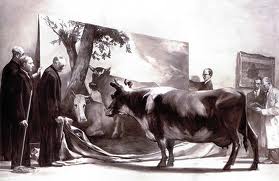
"The Innocent Eye Test," by Mark Tansey (1981)

The FT.com has reported that the Metropolitan Museum's website listed the Mark Tansey painting the subject of the recently filed claim against Gagosian gallery as "Partial and Promised Gift of Jan Cowles and Charles Cowles." And indeed it does -- here is the direct link. Last week, a spokesperson for Gagosian made a statement saying the gallery would "vigorously" defend the action and that Charles Cowles had "represented that he had clear title to the painting."


But shouldn't the gallery have done due diligence (granted, delicately) at the very least to confirm that its client had title to sell the consigned painting? Had they made even basic inquiries about the provenance of the painting the connection to the Met would have been revealed and a simple search of their website would have revealed the museum's interest in the painting. Surely the gallery doesn't just take representations of title made by prospective clients at face value (even if the seller is Charles Cowles)? The suit (which also comprises a claim over a cancelled sale of a Richard Prince nurse painting) will shed much-needed light on the inner workings of what is widely considered to be the most successful gallery in the world.

For background on the torts/property/fraud action brought by Robert Wylde against the Gagosian gallery see here.

Sunday, March 20, 2011

UK round-up

  • "UK art market loses out to "phenomenal" Chinese." FT.com reports on the European Art Foundation study revealing that the UK has lost its position as the second largest art market to China. According to the study "the UK's share of the global art market fell by 5 percentage points to 22 per cent in the four years to 2010." 
  • The Bolton Crown Court having declared the Amarna Princess a fake Egyptian scultpure created by Susan Greenhalgh and awarded ownership to the Metropolitan Police, it is now set to return Bolton Museum. Bolton councillor Elaine Sherrington says that in deciding to display the fake, they did not wish to "condone criminal activity" or "glamourise crime" but rather wanted to show that "even the most artful of forgers is eventually brought to justice" -- hardly the message most viewers are going to take away with them after they visit the display. How can this not glamourise crime? Displaying the sculpture is a mistake: the appropriate fate of a fake is shredding, incineration or stamping "so that no one will be fooled again."
  • "Any taxation that makes the wealthy feel less rich can have a chilling impact." Overview of recent tax changes in the UK and their potential impact on those who buy art.

Wednesday, March 16, 2011

UPDATED: If you don't ask, you definitely don't get

THE HAGUE. Louis Vuitton has filed its second lawsuit against Dutch artist Nadia Plesner, this time for using an image of the fashion house's Audra bag in her painting Darfurnica and continuing to display an image of the painting on her website. Although the latest suit can be distinguished from the 2008 suit filed in Paris in that Plesner is not currently using the image for merchandise (in 2008, she used the image on t-shirts and posters with 30% of proceeds going to charity), the use of the image still constitutes copyright infringement because Plesner did not obtain permission prior to its use.


Darfurnica, Nadia Plesner (2010)

According to New York Magazine, back in 2008, Plesner's failure to respond to the letter sent by Louis Vuitton prompted the company to go to court and seek injunctive relief, not damages (though I suspect that from Plesner's point of view, the latter would have preferable to restrictions on her freedom of expression). At the time, the plaintiff made two valid points: firstly, the need to uphold the rights of fellow artists Marc Jacobs and Takashi Murakami and secondly, the reality (both practical and legal) that if it didn't act to protect intellectual property rights, such rights would be jeopardised in the future. Whether these arguments were at the forefront of their actions is a different matter of course (there's little doubt that LVMH had, and still has, no interest in seeing its handbag portrayed in the context of the Darfur genocide).

The right to freedom of expression (a constitutionally protected right under the First Amendment of the US Constitution and a fundamental human right under Article 10 of the European Convention on Human Rights), is often mistaken for being an absolute right. Rather, it is a qualified right for not all speech is protected (think defamation, fighting words, obscene speech, fraudulent statements...) and the right in respect of that speech which is protected exists not in a vacuum but in a balancing act with other laws such as privacy, consumer protection and copyright, among others. In other words, Plesner's argument that her right to freedom of speech and expression and/or her charitable purposes should (or in fact do) trump any copyright infringement is inaccurate and misplaced. I wonder if what she meant to say is that there is/should be an exception to copyright infringement for artistic expression (as there is under US copyright laws). On the other hand, had she replied to Vuitton's letter in 2008 and requested permission to use the image in 2010 (probably also having to pay a fee for use of the image), each or both instances of litigation may have been avoided. What's clear is that ignoring the problem (and the law) is not the way to go.

UPDATE: for those that have suggested that I myself have engaged in copyright infringement by displaying the image, I would like to point out that I e-mailed the artist herself to request permission to display the image prior to publishing this post (something I do before every posting of an image of a work subject to copyright protection). Likewise, I would like to clarify that the references to privacy, consumer or other rights are merely illustrative -- they are not necessarily limiting the freedom of speech in this case. The intention was to show that the right was not absolute and that legal rights generally are in a constant state of balance and do not exist in insolation from each other.

Saturday, March 12, 2011

LINKS